Did Your Ingredient Checker Actually Recognize Every Name?
Check the returned ingredient names before trusting a skincare ingredient checker's summary. A result without a warning does not prove that every pasted name was recognized. In our synthetic-input test, an invented name disappeared from the displayed ingredient entries; a deliberately altered spelling also removed a warning. Keep unresolved names on your own review list rather than treating them as cleared.
What exactly did we test?
On November 3, 2026, we tested ScanSkinAI's free embedded comedogenic checker and SkinSort's web ingredient analyzer. These were text-interface experiments, not product formulas, skin tests, or evaluations of the separate ScanSkinAI full Product Scan. We used comma-separated synthetic lists and recorded the visible output. The invented name Testingredientxyz was intentionally meaningless.
What happened when we added an unknown name?
In ScanSkinAI, the control input Water, Glycerin produced one displayed ingredient entry: glycerin, rated 0/5 in the safe/low-risk group. Water had no separate output entry. Adding the invented third name, to make Water, Glycerin, Testingredientxyz, left that displayed result unchanged. The output still listed only glycerin. We did not see a separate unknown-name entry or a message identifying the invented token in the embedded result.
We then removed both real names and submitted only Testingredientxyz. Instead of an ingredient entry, the embedded checker displayed “No known comedogenic ingredients detected.” Its next sentence explicitly said that this did not guarantee the product would not cause breakouts. That caveat matters. This was not a successful identification of our invented substance, and the screen did not supply an ingredient-specific explanation for it.
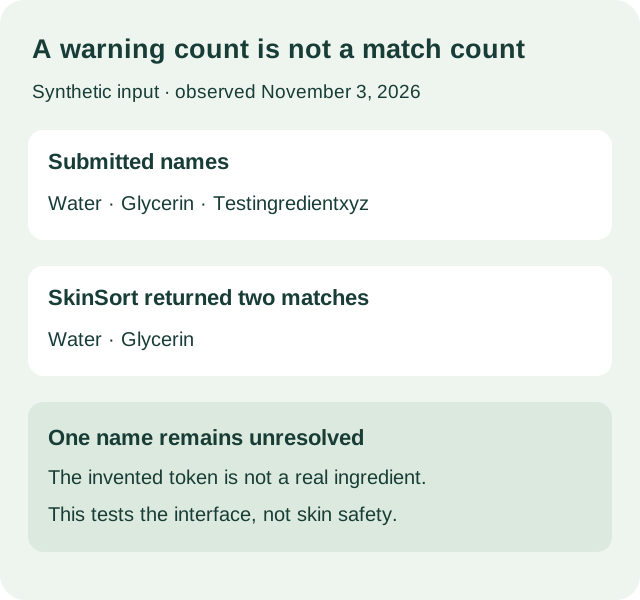
SkinSort received the same three-name input, Water, Glycerin, Testingredientxyz. Its saved result said it matched two ingredients and listed water and glycerin. The invented token did not appear in the returned ingredient list. Unlike the ScanSkinAI output, this interface supplied a matched-ingredient count that we could compare with our three submitted comma-separated names. That comparison exposed an unresolved entry; the count alone did not explain why it was missing.
Can one changed character remove a warning?
In a separate ScanSkinAI control, Water, Glycerin, Isopropyl Myristate displayed isopropyl myristate as a high-risk entry rated 5/5, alongside glycerin at 0/5. We changed only the final letter of the last name, submitting Water, Glycerin, Isopropyl Myristatx. The high-risk entry disappeared; only glycerin remained in the safe/low-risk output. The commas, first two names, and word order stayed the same.
This does not measure the checker's overall accuracy or prove that every misspelling fails. It demonstrates one spelling-sensitive result in the tested interface. The altered token is deliberately invalid. Restoring the exact label spelling is the appropriate next check; deleting a difficult name merely to obtain a cleaner summary would conceal the unresolved input.
How do you audit your own result?
Keep the original label beside the returned list. For each submitted name, record whether the result displays the same name, an explained alternative name, or no identifiable entry. Investigate the last category separately. A displayed warning count answers a different question from a matched-name count, and neither count supplies missing concentrations or product performance evidence.
SkinSort's own support page already discusses name variations and formatting failures. Its missing-ingredient instructions explain how to report an absent or incorrectly matched ingredient. Missing-name problems are therefore not a newly discovered general phenomenon. Our contribution here is the dated, repeatable input/output comparison above.
If your list has damaged separators, first check the copied text and ingredient boundaries. If all names are accounted for but warnings still differ, compare the score and warning category separately. This page's stopping point is narrower: an unresolved name stays unresolved even when the visible summary looks reassuring.